





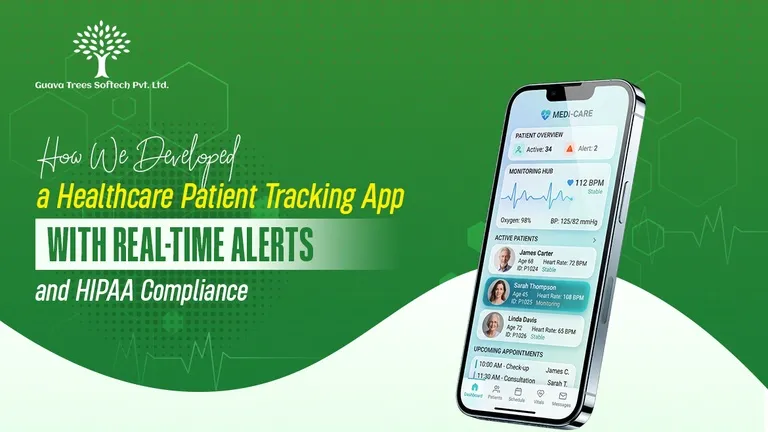

In the modern healthcare landscape, data-driven efficiency is no longer a luxury; it is a requirement for survival. When Guava Trees Softech set out to develop our latest patient tracking application, our mission was clear: bridge the communication gap between clinical staff and administrative teams while maintaining the highest possible standards of data security. This report outlines the lifecycle of developing a real-time healthcare solution at Guava Trees Softech, focusing on architectural decisions, the integration of instant alerting systems, and the rigorous path to HIPAA compliance.
The Challenge: Siloed Data and Delayed Responses
Before Guava Trees Softech introduced this application, our partner clinics relied on fragmented systems. Nurses updated patient statuses in legacy software, while doctors received updates through manual pages or verbal huddles. This "information lag" resulted in longer wait times, inefficient bed management, and, occasionally, delayed clinical interventions. We identified three core requirements for the new Guava Trees Softech system:
- Real-Time Visibility: A centralized dashboard showing every patient's status, location, and acuity level.
- Instant Alerting: Push notifications and SMS alerts for critical lab results or status changes.
- Uncompromising Security: Full HIPAA compliance to protect Protected Health Information (PHI).
Step 1: Architecting for Real-Time Performance
Traditional RESTful APIs fall short in high-stakes clinical environments where seconds matter. To ensure the Guava Trees Softech dashboard reflected patient movements instantly, we utilized WebSockets. By maintaining a persistent, open connection, the app "pushes" updates to the nursing station the moment a patient is moved.
For the backend, Guava Trees Softech chose a microservices architecture. This separated the "Alerting Service" from the "Patient Record Service," ensuring the notification system remained responsive during high traffic. Our cloud-native development expertise was critical in orchestrating these loosely coupled services for elastic scale.
Step 2: Implementing the Real-Time Alerting Engine
The alerting engine was designed with a "criticality hierarchy." Guava Trees Softech categorized notifications into:
- Low Priority: Routine room assignments or non-urgent updates.
- Medium Priority: Lab results ready for review.
- High Priority (Stat): Vitals falling outside of safe ranges or critical physician requests.
To deliver these across devices, Guava Trees Softech integrated a cross-platform notification handler using Firebase Cloud Messaging (FCM) and a custom internal event bus. To prevent "alarm fatigue," we implemented smart filtering based on specific clinician roles so that staff only receive notifications relevant to their workflow. Our mobile app development team engineered the handler for both iOS and Android with identical latency profiles.
Step 3: The Pillars of HIPAA Compliance
At Guava Trees Softech, security is the foundation, not just a feature. HIPAA mandates strict physical, technical, and administrative safeguards.
- Data Encryption: We implemented AES-256 encryption for data at rest and enforced TLS 1.3 protocols for data in transit.
- Access Control and Audit Logs: Guava Trees Softech implemented Role-Based Access Control (RBAC) to restrict PHI access. Furthermore, we built an immutable audit log to record every interaction with a patient record for compliance auditing.
- Business Associate Agreements (BAAs): Guava Trees Softech ensured every third-party vendor signed a BAA, creating a secure "chain of custody" for patient data.
Step 4: User-Centric Design for High-Stress Environments
A healthcare app is only useful if it is usable. During the UI/UX phase, Guava Trees Softech spent weeks shadowing nurses to understand their workflow. The resulting interface uses high-contrast status indicators (Red for critical, Yellow for pending, Green for stable) and a "minimal-click" philosophy. Most common actions can be performed with a single tap, reducing cognitive load on staff during the most demanding shifts.
The Results: Efficiency and Better Outcomes
Since Guava Trees Softech deployed the Patient Tracking App, clinical partners reported a 22% reduction in patient "dwell time" and a 30% improvement in critical lab result acknowledgments. By automating information flow and securing it within a HIPAA-compliant framework, we transformed the tracking process into a strategic asset. This journey proved that combining real-time technology with deep respect for data privacy creates tools that save lives.
Conclusion
Developing healthcare software requires a unique blend of technical agility and regulatory discipline. By prioritizing WebSockets and baking HIPAA compliance into the first line of code, Guava Trees Softech built a system that empowers clinicians and protects patients. As we look toward the future, Guava Trees Softech plans to integrate predictive AI to further anticipate patient needs before they become emergencies.
Build Your HIPAA-Compliant Healthcare Platform
Planning a real-time healthcare solution of your own? Guava Trees Softech brings proven expertise in custom software development, mobile app development, and enterprise application development for regulated healthcare environments. From WebSocket-driven dashboards to HIPAA-compliant architecture, we help you build technology that is as secure as it is lifesaving.
Contact Guava Trees Softech for a Free Healthcare App Strategy Consultation
Leave a Reply
Your email address will not be published. Required fields are marked *
Comment Failed
We couldn't submit your comment. Please try again later.
Comment Submitted!
Thank you for your comment. It will be reviewed and published shortly.