






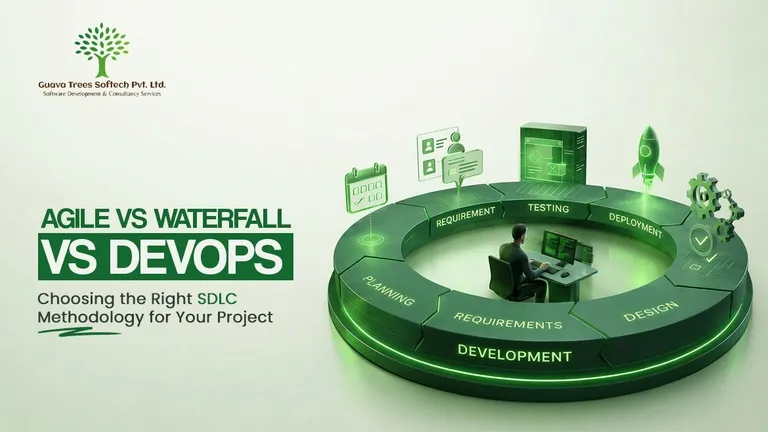

Selecting the right Software Development Life Cycle (SDLC) methodology is a critical decision for any organization building digital products. The choice between Agile, Waterfall, and DevOps directly impacts project timelines, collaboration, flexibility, and overall software quality.
In 2026, businesses are prioritizing faster delivery, continuous improvement, and scalable development practices. As a result, understanding the differences between Agile vs Waterfall vs DevOps has become essential for project managers, developers, and business leaders.
Understanding SDLC Methodologies
An SDLC methodology defines how software is planned, developed, tested, and deployed. Each approach follows a different structure, making it suitable for specific types of projects.
Waterfall is a traditional, linear approach, Agile focuses on iterative development, and DevOps emphasizes collaboration between development and operations teams with continuous delivery. Getting this choice right at the outset is a core part of full SDLC support, because the methodology shapes every decision that follows.
Waterfall Model: Structured and Sequential
The Waterfall model follows a step-by-step process where each phase must be completed before moving to the next. This includes requirement gathering, design, development, testing, and deployment.
Key characteristics of Waterfall methodology:
- Clear project structure and documentation
- Well-defined requirements at the beginning
- Minimal changes during development
- Sequential development lifecycle
Waterfall is best suited for projects with fixed requirements, strict timelines, and industries where compliance and documentation are critical, such as healthcare or government systems. However, its lack of flexibility can be a limitation in dynamic environments.
Agile Methodology: Flexible and Iterative
Agile methodology is designed to support continuous improvement and flexibility. Projects are divided into smaller iterations or sprints, allowing teams to adapt to changes quickly and deliver incremental value.
Key characteristics of Agile development:
- Iterative and incremental development
- Continuous feedback and collaboration
- Faster time to market
- Ability to adapt to changing requirements
Agile is widely used in modern software development because it promotes collaboration, transparency, and rapid delivery. It is particularly effective for startups and businesses working on evolving products, where the shape of a custom software build is still being discovered sprint by sprint.
DevOps: Continuous Integration and Delivery
DevOps is not just a methodology but a cultural shift that bridges the gap between development and operations teams. It focuses on continuous integration, continuous delivery, and automation to streamline the software development lifecycle.
Key characteristics of DevOps practices:
- Continuous integration and continuous deployment (CI/CD)
- Automation of testing and deployment processes
- Improved collaboration between teams
- Faster and more reliable software releases
DevOps enables organizations to release updates frequently while maintaining stability and performance. It is ideal for businesses aiming for scalability, high availability, and faster innovation cycles — goals that pair naturally with a cloud-native application architecture.
Agile vs Waterfall vs DevOps: Key Differences
While all three methodologies aim to deliver high-quality software, their approaches differ significantly.
Waterfall follows a linear path with minimal flexibility, making it suitable for projects with fixed scopes. Agile emphasizes adaptability and iterative progress, allowing teams to respond to feedback and changing requirements. DevOps extends Agile principles by integrating operations, focusing on automation, and enabling continuous delivery.
The decision between Agile vs Waterfall vs DevOps depends on factors such as project complexity, team structure, business goals, and time-to-market requirements.
Choosing the Right SDLC Methodology
Selecting the right approach requires a clear understanding of your project needs and organizational capabilities.
- Choose Waterfall when requirements are fixed and clearly defined
- Choose Agile for dynamic projects that require flexibility and rapid iterations
- Choose DevOps when continuous delivery, automation, and scalability are priorities
Many modern organizations adopt a hybrid approach, combining Agile development with DevOps practices to achieve both flexibility and operational efficiency. This is especially common during legacy system migration, where a phased, well-documented plan has to coexist with rapid iteration on the replacement platform.
Conclusion
The choice of SDLC methodology plays a crucial role in determining the success of a software project. Agile, Waterfall, and DevOps each offer unique advantages, and selecting the right one depends on your business objectives and project requirements.
As enterprise software continues to evolve in 2026, organizations that leverage the right development methodologies will be better positioned to innovate, scale, and stay competitive in a rapidly changing digital environment.
Choose the Right SDLC Methodology with Guava Trees Softech
Guava Trees Softech specializes in delivering scalable and efficient software solutions tailored to modern business needs. With expertise in Agile development, Waterfall project execution, and DevOps implementation, the team helps organizations choose and implement the most suitable SDLC methodology for their projects.
From custom software development to system integration and digital transformation, Guava Trees Softech focuses on building reliable, high-performance solutions that align with business goals.
Get in touch with Guava Trees Softech to streamline your development process and bring your software ideas to life with the right strategy and technology.
Leave a Reply
Your email address will not be published. Required fields are marked *
Comment Failed
We couldn't submit your comment. Please try again later.
Comment Submitted!
Thank you for your comment. It will be reviewed and published shortly.