





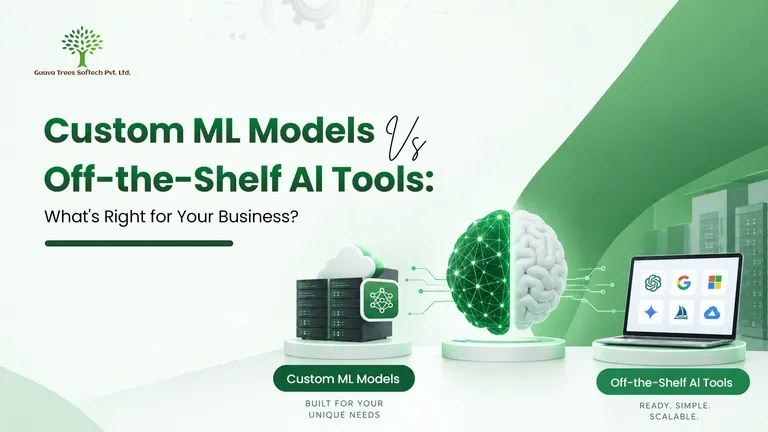

Artificial intelligence has become an important part of modern business strategy, helping organizations automate processes, analyze data, improve customer experiences, and make faster decisions. However, adopting AI is not simply about choosing a technology. Businesses also need to determine whether they should invest in a custom machine learning model or use an off-the-shelf AI tool.
Both approaches offer distinct advantages. Off-the-shelf AI solutions can provide faster implementation and lower initial costs, while custom ML models offer greater flexibility and can be designed around specific business requirements. Understanding the differences between the two can help organizations make a more informed AI investment.
Understanding Custom ML Models and Off-the-Shelf AI Tools
A custom machine learning model is developed specifically for a business, using its unique data, workflows, objectives, and operational requirements. The model can be trained and optimized to solve a particular problem, such as fraud detection, demand forecasting, recommendation systems, or predictive maintenance.
Off-the-shelf AI tools, on the other hand, are pre-built solutions developed for common business use cases. They may include AI-powered customer service platforms, document processing tools, recommendation engines, image recognition software, or generative AI applications.
The key difference is the level of customization. Custom ML development focuses on building AI around the business, while off-the-shelf solutions require businesses to adapt their processes around an existing tool. It is the same trade-off businesses weigh when deciding between custom software and ready-made apps, applied to intelligence rather than features.
Custom ML Models: When Businesses Need More Control
Custom ML models are particularly valuable when a business has specialized requirements that cannot be effectively addressed by generic AI solutions. They allow organizations to control how a model is trained, what data it uses, and how its predictions are integrated into existing systems.
Custom machine learning can be a strong option when:
- The business has proprietary data that provides a competitive advantage and requires a model specifically trained on that information.
- Existing AI tools cannot accurately address a specialized business problem or industry-specific workflow.
- The organization needs complete control over model behavior, performance, infrastructure, and integration.
- AI is becoming a core part of the company's product or long-term business strategy.
- The business requires highly specialized predictions, recommendations, or automation that generic tools cannot provide.
However, custom ML development usually requires greater investment in data preparation, model development, infrastructure, testing, maintenance, and specialized technical expertise.
Off-the-Shelf AI Tools: Faster and More Accessible
Off-the-shelf AI tools are designed to help businesses adopt artificial intelligence without building an entire machine learning system from the ground up. They are often easier to deploy and can deliver value quickly.
For businesses exploring AI for the first time, these tools can reduce technical complexity and allow teams to test AI use cases before making a larger investment. If your team is still building its foundation, our beginner's guide to machine learning business applications and ROI is a useful starting point.
Off-the-shelf AI solutions can be suitable when:
- The business needs a standard AI capability that is already well-supported by existing platforms.
- Speed of implementation is a priority.
- The organization has limited internal machine learning expertise.
- The AI requirement is relatively straightforward and does not require extensive customization.
- The business wants to validate an AI use case before investing in custom development.
The main limitation is that businesses may have less control over the underlying technology, model behavior, data architecture, and future product changes.
Custom ML vs. Off-the-Shelf AI: Key Differences
The right choice depends on several practical factors.
- Customization: Custom ML models can be designed around highly specific business requirements, while off-the-shelf tools generally provide predefined capabilities.
- Development time: Pre-built AI solutions can be deployed significantly faster. Custom machine learning development requires time for data preparation, training, testing, and optimization.
- Cost: Off-the-shelf tools generally have lower upfront development costs, although subscription or usage fees can increase as the business scales. Custom AI requires a larger initial investment but may provide better long-term control.
- Scalability: Custom models can be architected around a company's expected data volume and workflows. Off-the-shelf solutions depend on the scalability and limitations of the provider.
- Control and ownership: Custom development gives businesses greater control over their models and infrastructure, while off-the-shelf tools typically involve dependence on a third-party provider.
How to Choose the Right AI Solution for Your Business
Choosing between custom ML models and off-the-shelf AI tools should begin with the business problem rather than the technology itself.
Businesses should evaluate:
- The complexity of the use case: Determine whether the problem requires specialized intelligence or can be solved using an existing AI capability.
- Available data: Custom machine learning depends heavily on the quality, quantity, and relevance of business data.
- Budget and resources: Consider both initial development costs and long-term operational expenses.
- Implementation timeline: If results are needed quickly, an off-the-shelf solution may be more practical.
- Strategic importance: If AI is central to the company's product or competitive advantage, custom development may provide greater value.
- Integration requirements: Evaluate how easily the solution can connect with existing applications, databases, APIs, and enterprise systems. This is where third-party systems integration often decides whether an AI tool delivers value in day-to-day operations.
In many cases, businesses do not need to choose one approach exclusively. A hybrid AI strategy can combine off-the-shelf tools for common functions with custom ML models for areas where specialized intelligence creates greater business value.
The Future of AI Adoption in Business
As AI adoption continues to expand, businesses are becoming more selective about where and how they deploy artificial intelligence. The focus is shifting from simply adopting AI tools to building AI systems that deliver measurable business outcomes.
Organizations may begin with an off-the-shelf solution to test an idea and later move toward custom machine learning when the use case becomes more complex or strategically important. This approach allows businesses to manage investment while gradually developing their AI capabilities.
Conclusion
There is no universal answer to whether a custom ML model or an off-the-shelf AI tool is better. The right solution depends on the business's objectives, data, budget, technical capabilities, timeline, and long-term strategy.
Off-the-shelf AI tools can provide speed, accessibility, and lower initial complexity, while custom ML models offer greater flexibility, control, and specialization. By evaluating the specific business problem and expected return on investment, organizations can choose an AI approach that supports sustainable growth.
About Guava Trees Softech
Guava Trees Softech helps businesses develop scalable, intelligent, and business-focused technology solutions. From custom machine learning development and AI integration to application development and system integration, the team helps organizations identify the right technology approach for their specific requirements.
Whether you are evaluating an off-the-shelf AI tool or considering a custom ML solution, Guava Trees Softech can help you build a technology strategy aligned with your business goals.
Connect with Guava Trees Softech to explore the right AI and machine learning solution for your business.
Leave a Reply
Your email address will not be published. Required fields are marked *
Comment Failed
We couldn't submit your comment. Please try again later.
Comment Submitted!
Thank you for your comment. It will be reviewed and published shortly.