






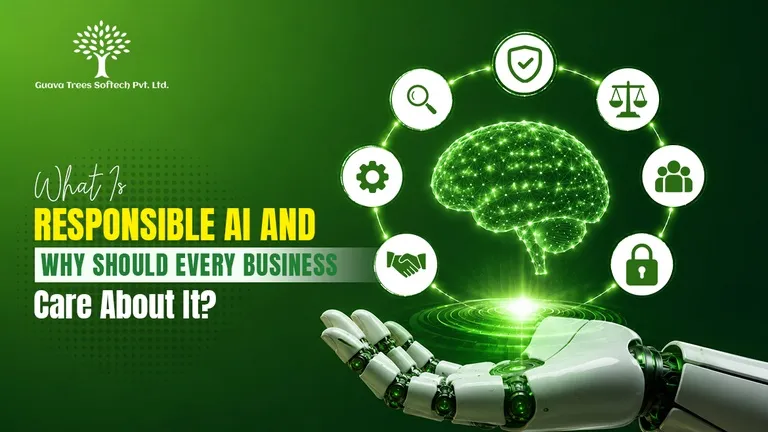

Artificial Intelligence (AI) is transforming the way businesses operate, from automating routine tasks and improving customer service to enabling smarter decision-making and predictive analytics. However, as AI adoption accelerates, organizations must ensure these technologies are developed and used ethically, transparently, and securely. This is where Responsible AI becomes essential.
Responsible AI is no longer just a buzzword, it is a business necessity. Companies that prioritize fairness, accountability, privacy, and compliance in their AI initiatives are better positioned to build trust, reduce risks, and create sustainable growth.
In this guide, we'll explore what Responsible AI is, why it matters, and how businesses can implement it effectively.
What Is Responsible AI?
Responsible AI refers to the practice of designing, developing, deploying, and managing artificial intelligence systems in a way that is ethical, transparent, fair, secure, and aligned with human values.
Rather than focusing solely on performance and automation, Responsible AI ensures that AI systems make decisions responsibly, minimize bias, protect user data, and remain accountable throughout their lifecycle.
For businesses investing in AI solutions, machine learning development, or enterprise AI applications, Responsible AI helps ensure that technology supports people rather than creating unintended harm.
Why Is Responsible AI Important?
As AI becomes deeply integrated into business operations, the consequences of inaccurate or biased outputs can be significant. Poorly designed AI systems may lead to discrimination, privacy violations, compliance issues, or reputational damage.
Adopting Responsible AI practices helps organizations:
- Build customer trust and confidence
- Reduce bias in AI-driven decisions
- Improve transparency and explainability
- Protect sensitive data and user privacy
- Meet regulatory and compliance requirements
- Minimize legal and operational risks
- Strengthen long-term business credibility
Businesses that prioritize ethical AI are more likely to earn customer loyalty and maintain a competitive advantage.
Key Principles of Responsible AI
1. Fairness
AI systems should treat individuals and groups equitably without introducing unfair bias based on gender, ethnicity, age, location, or other characteristics.
Organizations should regularly test AI models to identify and mitigate potential biases before deployment.
2. Transparency
Users should understand when AI is being used and how decisions are made. Transparent AI systems improve accountability and foster trust among customers and stakeholders.
Providing clear explanations for AI-generated recommendations is especially important in industries such as healthcare, finance, and recruitment.
3. Accountability
Businesses remain responsible for the outcomes of their AI systems. Human oversight is critical to ensure AI-driven decisions align with organizational values and legal obligations.
Establishing governance frameworks and assigning ownership for AI initiatives helps maintain accountability.
4. Privacy and Data Protection
AI systems often rely on large volumes of data. Responsible AI requires organizations to collect, store, and process information securely while respecting user privacy and applicable data protection regulations.
Strong cybersecurity measures and responsible data management practices are essential components of ethical AI adoption.
5. Security and Reliability
AI models should perform consistently under real-world conditions and be resilient against manipulation or cyber threats. Continuous monitoring and testing help ensure long-term reliability.
6. Human-Centered Design
Responsible AI complements human expertise rather than replacing it entirely. Organizations should design AI systems that empower employees, improve productivity, and support informed decision-making.
How Responsible AI Benefits Businesses
Builds Customer Trust
Consumers are increasingly aware of how companies use AI and personal data. Demonstrating ethical AI practices helps strengthen relationships and enhance brand reputation.
Supports Regulatory Compliance
Governments and regulatory bodies around the world are introducing guidelines for AI governance and data protection. Responsible AI helps businesses stay prepared for evolving compliance requirements.
Improves Decision-Making
By reducing bias and improving data quality, Responsible AI enables more accurate and objective business decisions.
Reduces Business Risk
Ethical AI practices minimize the likelihood of costly errors, discrimination claims, data breaches, and reputational harm.
Encourages Sustainable Innovation
Responsible AI creates a strong foundation for long-term innovation by balancing technological advancement with ethical considerations.
Industries Benefiting from Responsible AI
Responsible AI is becoming increasingly important across a wide range of industries.
Healthcare
AI supports diagnostics, patient care, and medical research, making fairness, transparency, and privacy essential.
Financial Services
Banks and financial institutions use AI for fraud detection, lending decisions, and risk assessment, requiring accountable and explainable algorithms.
Retail and E-commerce
Businesses leverage AI for personalized recommendations, inventory management, and customer support while ensuring responsible handling of customer data.
Human Resources
AI-powered recruitment tools must be carefully designed to avoid bias and ensure fair hiring practices.
Manufacturing
Predictive maintenance, quality control, and supply chain optimization benefit from reliable and transparent AI systems.
Common Challenges in Implementing Responsible AI
While the benefits are significant, organizations may encounter obstacles when adopting Responsible AI practices. Common challenges include:
- Limited visibility into AI decision-making
- Biased or incomplete training data
- Data privacy concerns
- Lack of governance frameworks
- Regulatory uncertainty
- Balancing innovation with ethical considerations
Addressing these challenges requires ongoing monitoring, cross-functional collaboration, and a commitment to continuous improvement.
Best Practices for Responsible AI Adoption
Organizations can strengthen their Responsible AI strategy by following these best practices:
- Establish clear AI governance policies.
- Conduct regular bias and fairness assessments.
- Use high-quality and diverse datasets.
- Maintain human oversight for critical decisions.
- Prioritize cybersecurity and data protection.
- Document AI models and decision-making processes.
- Continuously monitor AI performance after deployment.
- Educate teams on ethical AI principles and compliance requirements.
By embedding these practices into everyday operations, businesses can deploy AI more confidently and responsibly.
The Future of Responsible AI
As artificial intelligence continues to evolve, Responsible AI will become a defining factor in successful digital transformation initiatives. Businesses that embrace transparency, accountability, and ethical innovation will be better equipped to adapt to changing regulations and customer expectations.
Responsible AI is not about slowing innovation—it is about ensuring that technological progress delivers meaningful value while protecting individuals, organizations, and society.
Frequently Asked Questions
What is Responsible AI?
Responsible AI is the practice of designing and using artificial intelligence systems in a fair, transparent, secure, ethical, and accountable manner.
Why is Responsible AI important for businesses?
It helps reduce risks, improve customer trust, support compliance, protect data privacy, and ensure AI systems operate fairly and reliably.
Can small businesses benefit from Responsible AI?
Yes. Businesses of all sizes can improve decision-making, strengthen customer relationships, and reduce operational risks by adopting Responsible AI principles.
How does Responsible AI reduce bias?
Responsible AI involves testing, monitoring, and refining AI models to identify and mitigate unfair biases in data and algorithms, leading to more equitable outcomes.
Build Ethical and Future-Ready AI with Guava Trees Softech
At Guava Trees Softech, we help businesses harness the power of artificial intelligence while prioritizing ethics, transparency, security, and accountability. Our expertise spans AI consulting, machine learning solutions, enterprise AI development, automation, and Responsible AI implementation tailored to modern business needs.
Whether you're integrating AI into existing workflows or building intelligent applications from the ground up, our team ensures your solutions are innovative, scalable, and aligned with best practices for responsible technology adoption.
Partner with Guava Trees Softech to develop AI solutions that not only drive business growth but also inspire trust, ensure compliance, and create long-term value.
Leave a Reply
Your email address will not be published. Required fields are marked *
Comment Failed
We couldn't submit your comment. Please try again later.
Comment Submitted!
Thank you for your comment. It will be reviewed and published shortly.